Hermès shares fell 20.8%; median tracked USD Birkin asking index stayed flat
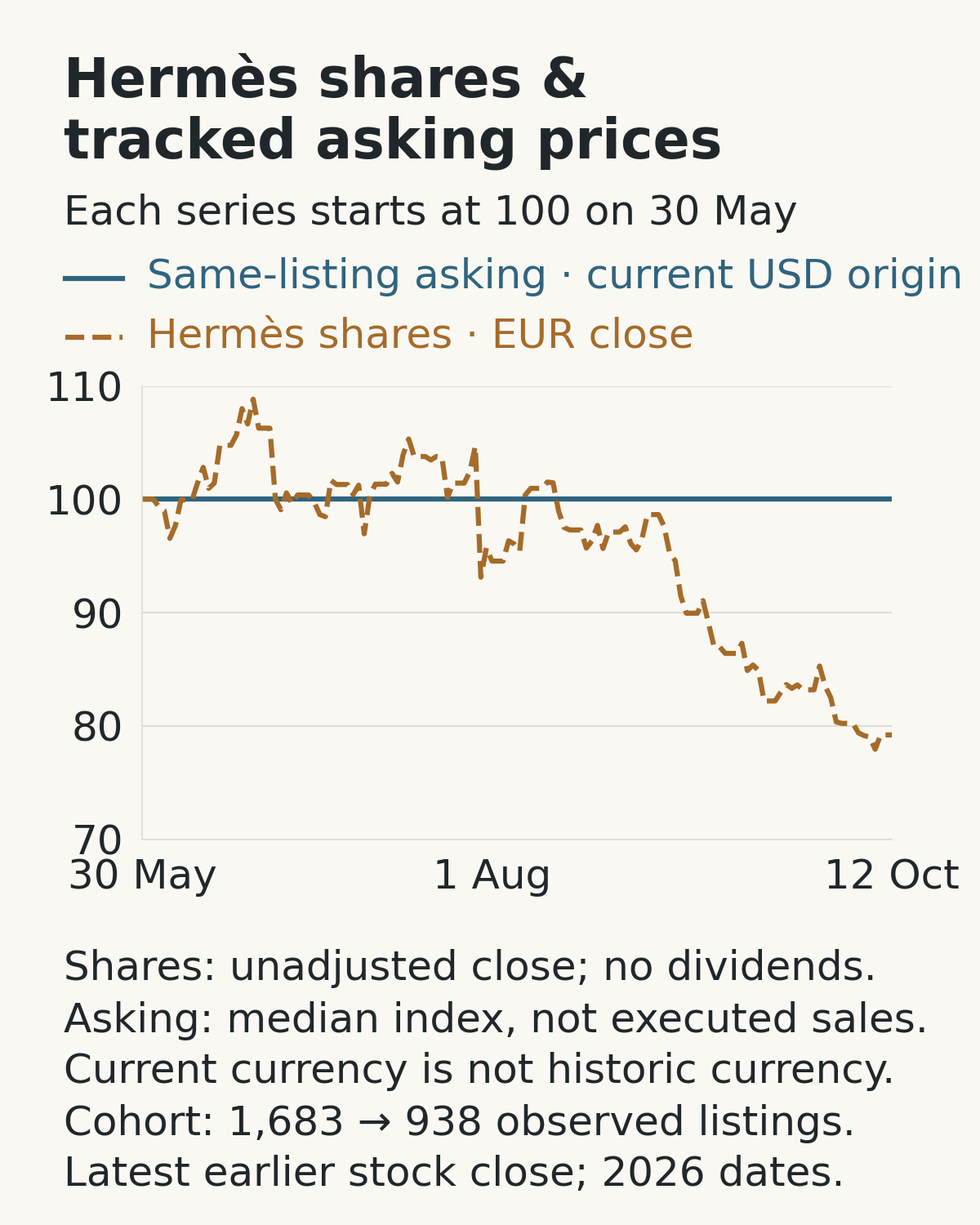
Hermès shares fell 20.8% between the closing prices on 29 May and 9 October 2026. Across the nearby 135-day span from 30 May to 12 October, the median asking-price index for the same tracked Birkin listings priced in US dollars at source stayed at 100. The asking window begins one day later and ends three days later than the stock window; these are closely overlapping periods, not identical dates.
The findings offer context for Hermès' third-quarter results: revenue of €4.1 billion, up 4.3% at constant exchange rates (5.5% as published), according to the company's 22 October release. Our evidence concerns advertised prices and a limited set of auction sales. Those are different views of the market, each with its own blind spots.
A share price and an asking price answer different questions. The former records a trade in a listed company; the latter records what a seller advertises for an individual bag. A price that stays visible can coexist with negotiation, a long wait for a buyer or no sale. Persistence on the shelf cannot establish demand by itself.
The chart expresses each recorded asking price relative to its own baseline value, then takes the median among listings observed on both dates. Its USD cohort starts with 1,683 listings and ends with 938. The median stays at 100 across the observed series, but the listings observed change over time. This describes the tracked listings, not every Birkin or the proceeds from selling bags.
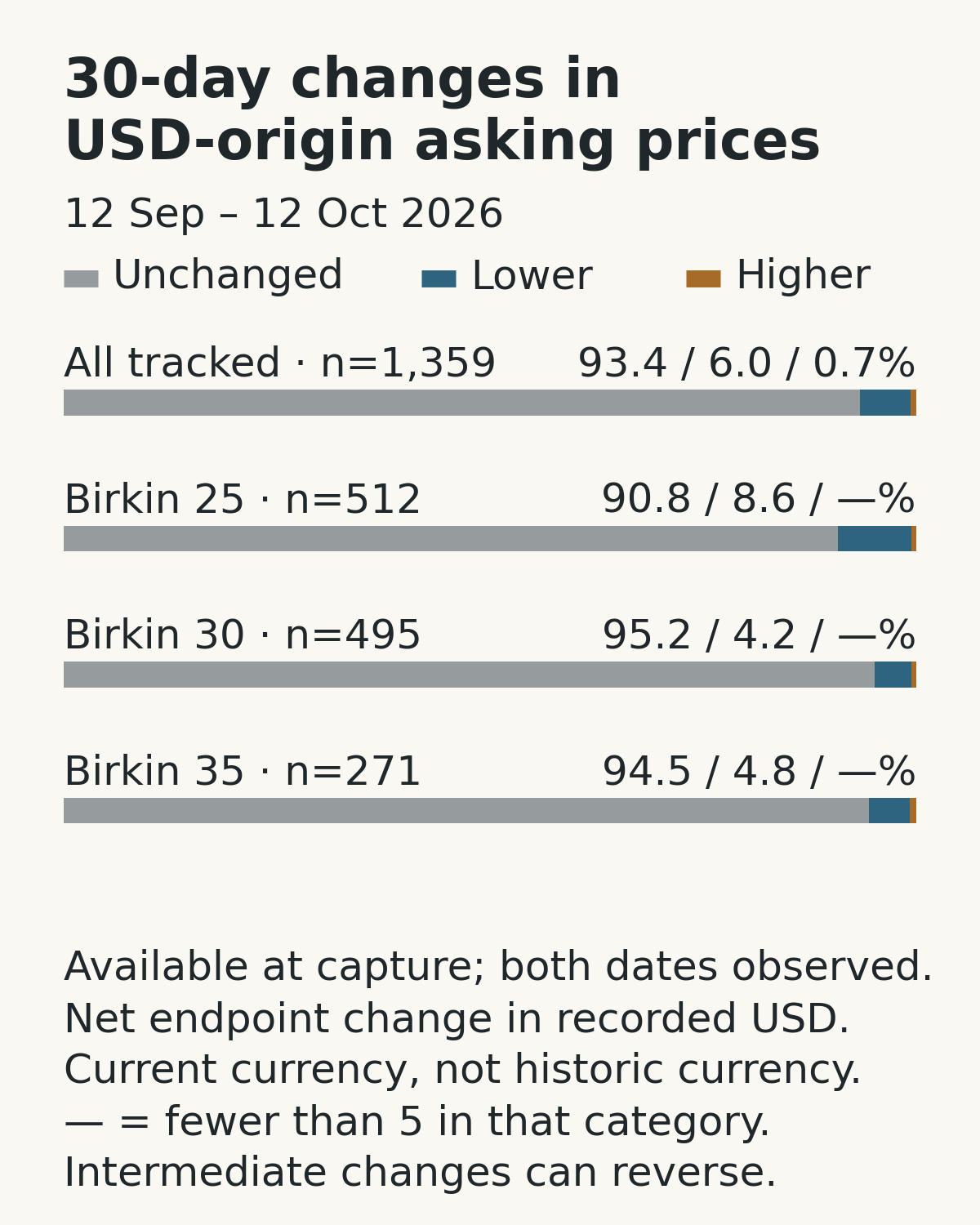
A separate 30-day comparison, 12 September–12 October, adds detail: 93.4% of 1,359 matched, still-active USD-origin listings ended at the same recorded asking price; 6.0% ended lower and 0.7% higher. Those percentages describe net endpoint changes in the shorter window, not the whole baseline period.
The flat majority deserves a closer look. Of the listings that ended at the same recorded price, 8 had changed during the window and subsequently returned. So “unchanged” means unchanged between the endpoints. It does not mean untouched throughout the month. Among listings ending lower, the median decline was 2.1%, with lower endpoints across 6 distinct resellers.
The currency restriction matters. Outside this USD cohort, 119 listings showed increases rounding to +32.34%, all with current native GBP currency. They represented 6.0% of 1,990 original matched listings across currencies. That repeated pattern does not identify its cause. Non-USD asks are converted at daily reference rates; changes mix price and currency moves. The frozen history does not identify the rate applied to each record. We therefore separate them from the main finding.
Current currency is the label at our capture, not a historical currency record. Selecting USD reduces direct exposure to currency conversion, but cannot establish that a listing used dollars throughout its history or rule out changes in the data record. A lower endpoint is not necessarily a seller's discount.
Auction results give another perspective. After including realised prices with the buyer's commission, 8 model, size and leather-family groups met our minimum sample requirement. Some also supported a narrower comparison by exact leather. These are overlapping cuts, so they should not be added together. Hammer prices and commission-inclusive prices remain separate throughout.
Consider regular-leather Birkin 25s. We compared 9 auction results from 6–9 October with 903 current asking prices. The median realised-to-asking ratio was 0.745, with an interquartile range of 0.597–0.913. Restricting the comparison to Togo leather gave 6 auction results and 662 asking prices, a median ratio of 0.771 and an interquartile range of 0.634–0.934. Both examples use realised prices including buyer's commission.
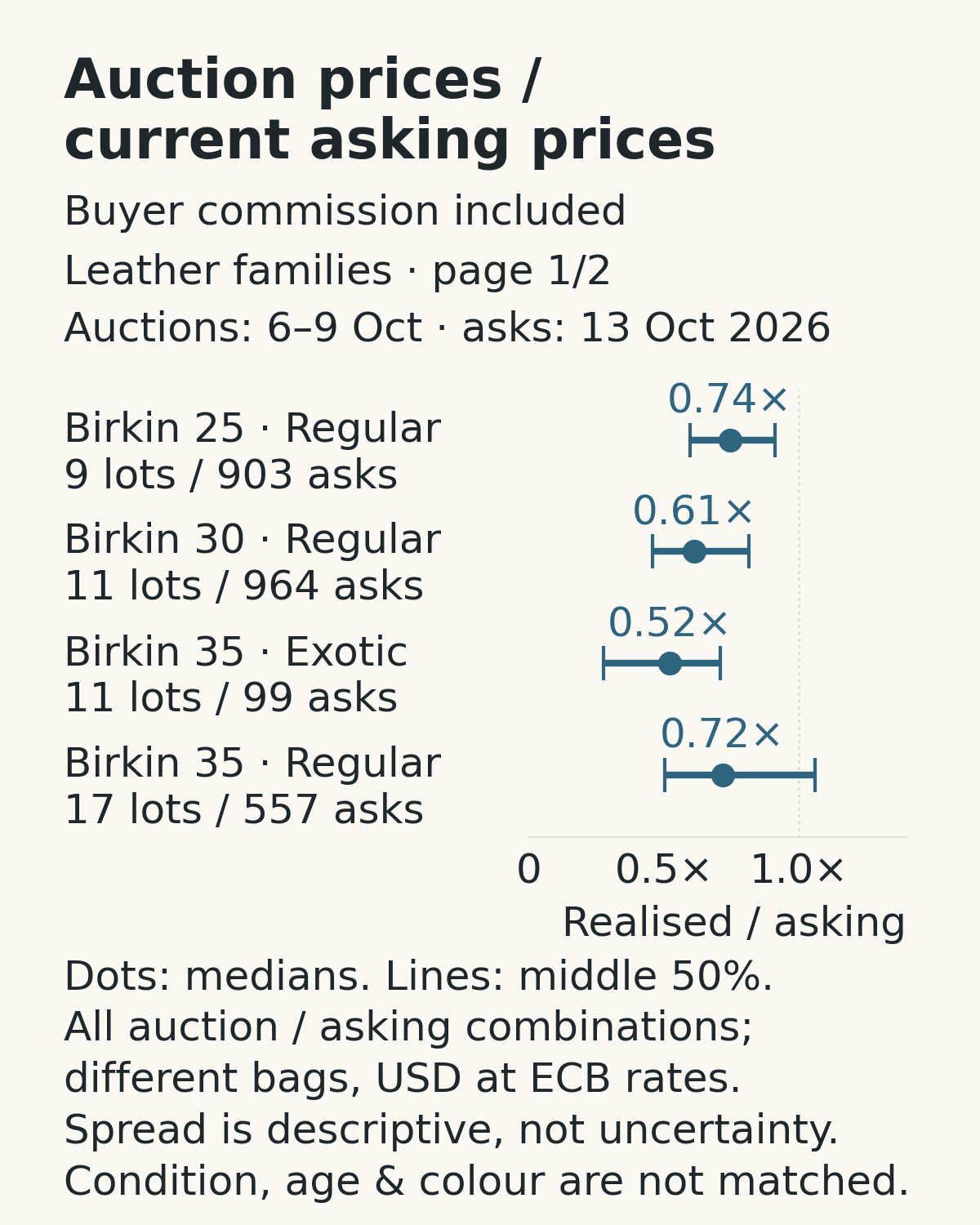
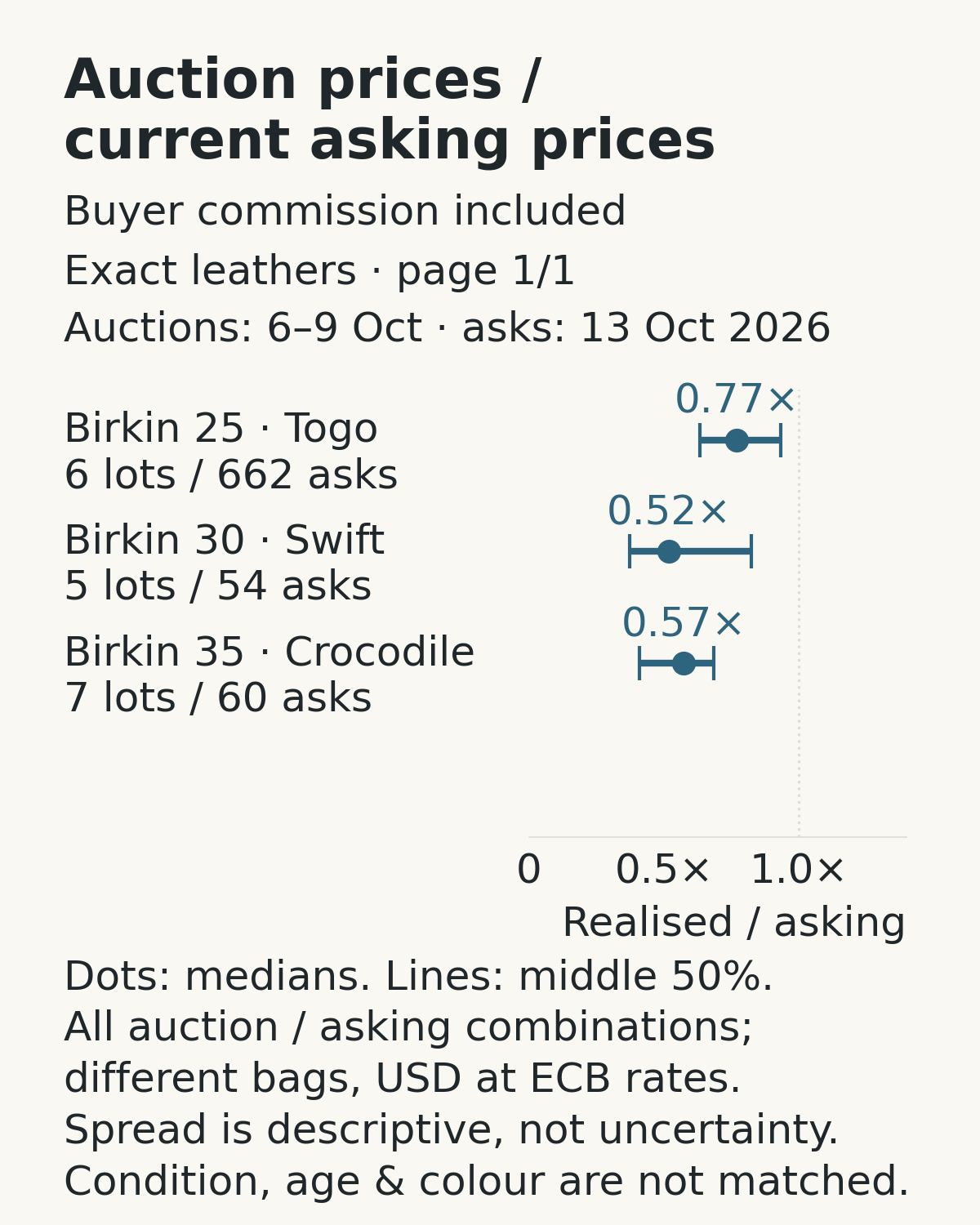
To read those ratios correctly, imagine comparing each auction result with every asking price in its group, then taking the middle ratio. We are not following the same physical bag from a reseller's shelf into an auction room. The interquartile range shows the spread of these comparisons, not statistical confidence in a universal market gap. The many combinations do not create more independent auction sales.
Matching size and leather narrows the question, but leaves condition, age, colour and hardware unresolved. Taxes and shipping are also unmatched, and a commission-inclusive auction result need not equal the final cost of getting a bag home. The figures therefore cannot establish a general discount available across the resale market.
The method is deliberately brief. We use listings we track daily through 12 October, with active status checked at the 13 October capture; size cuts use current bag metadata. Stock closes come from Euronext. We deduplicate the auction results we collect by house, sale and lot. Each published auction group requires at least 5 sold lots and 5 asks. For these comparisons only, we convert native amounts to dollars using ECB reference rates, downloaded 14 October, on the sale or capture date, or the latest earlier published rate when necessary. The daily asking history remains as recorded in dollars.
From the auction room
What draws buyers to Hermès sales right now?
“Iconic pieces like the Birkin and Kelly remain highly sought after, but we are also seeing growing interest in rare and historic creations, notably Martin Margiela's designs for Hermès, which have achieved remarkable results in our sales.”
Original (French)
« Les pièces iconiques comme les Birkin et Kelly restent très recherchées, mais nous constatons également un intérêt croissant pour les créations rares et historiques, notamment celles de Martin Margiela pour Hermès, qui ont obtenu des résultats remarquables lors de nos ventes. »
What explains the gap between reseller asking prices and hammer prices?
“Unlike prices set by resellers, auctions directly reflect collector demand. Rarity, condition and provenance can push prices up considerably, sometimes far beyond estimates and market prices.”
Original (French)
« Contrairement aux prix fixés par les revendeurs, les enchères reflètent directement la demande des collectionneurs. La rareté, l'état et la provenance peuvent faire considérablement grimper les prix, parfois bien au-delà des estimations et des prix du marché. »
Method and limits
Each observed source-USD listing is indexed to its own baseline asking price; the median is taken among IDs present at baseline and on the observation date. The observed cohort varies over time.
Same listing IDs observed at both endpoints and still available at capture; net change in recorded dollar asking price. USD origin is selected using the frozen current currency label.
Unadjusted Hermès EUR closing prices from Euronext; dividends excluded.
All pairs of realised prices including buyer's commission and current asks within the model, size and leather group; native amounts converted once using ECB reference rates. Groups overlap.
- Source currency is the label at capture, not a historical currency record; selecting USD does not certify unchanged currency or processing throughout the history.
- Asking prices are advertisements, not completed sales. Disappearance does not identify a sale. Flat endpoints can conceal intermediate changes.
- Different bags; condition, age, colour, hardware, taxes and shipping are unmatched. Interquartile ranges describe the spread of all-pairs ratios, not confidence intervals.
- The equity and asking windows overlap closely but have different endpoints. These observations do not identify a causal relationship between the series. Captures are non-atomic and auction and asking captures are not simultaneous.
- The median same-listing USD asking index stayed at 100 from 30 May to 12 October; n=1,683 initially and 938 finally.
Method and caveat
Each observed source-USD listing is indexed to its own baseline asking price; the median is taken among IDs present at baseline and on the observation date. The observed cohort varies over time.
Source currency is the label at capture, not a historical currency record; selecting USD does not certify unchanged currency or processing throughout the history. Asking prices are advertisements, not completed sales. Disappearance does not identify a sale. Flat endpoints can conceal intermediate changes.
- 93.4% of 1,359 matched USD-origin listings ended unchanged over 30 days to 12 October; 6.0% ended lower and 0.7% higher.
Method and caveat
Same listing IDs observed at both endpoints and still available at capture; net change in recorded dollar asking price. USD origin is selected using the frozen current currency label.
Asking prices are advertisements, not completed sales. Disappearance does not identify a sale. Flat endpoints can conceal intermediate changes. Rounded percentages may not sum to the whole.
- Regular-leather Birkin 25: median realised-to-asking ratio 0.745; interquartile range 0.597–0.913; 9 auction results and 903 asks.
Method and caveat
All pairs of realised prices including buyer's commission and current asks within the model, size and leather group; native amounts converted once using ECB reference rates. Groups overlap.
Different bags; condition, age, colour, hardware, taxes and shipping are unmatched. Interquartile ranges describe the spread of all-pairs ratios, not confidence intervals.
- Togo Birkin 25: median realised-to-asking ratio 0.771; interquartile range 0.634–0.934; 6 auction results and 662 asks.
Method and caveat
All pairs of realised prices including buyer's commission and current asks within the model, size and leather group; native amounts converted once using ECB reference rates. Groups overlap.
Different bags; condition, age, colour, hardware, taxes and shipping are unmatched. Interquartile ranges describe the spread of all-pairs ratios, not confidence intervals.
BirkinBagStock research team
Independent, not affiliated with Hermès. See the live Birkin Resale Price Index, which uses a later data cut, and other reports.